In my current focus on how to age better at a cellular level, you cannot talk about longevity and better aging without talking about mitochondria. Mitochondria are the powerhouse of every cell in your body. When looking at beauty, the mitochondria effect on skin and hair becomes the focus.
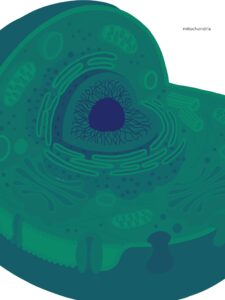
Mitochondria regulate skin health by providing ATP (energy) for collagen synthesis, keratinocyte (skin cell) proliferation, and melanocyte (pigment cells) homeostasis.
Mitochondrial function declines due to chronologic aging, UV exposure, and stressors. This causes mitochondrial DNA mutations to accumulate, oxidative phosphorylation becomes impaired, and reactive oxygen species damage cells. This leads to inflammation, loss of extracellular matrix, and accelerates the loss of fibroblasts. Fibroblasts are key for collagen synthesis and skin firmness and elasticity.
This deep science is hard to grasp. The real question is what does this mitochondrial dysfunction look like? What do you see?
Have you heard of androgenetic alopecia? (AGA)? Mitochondrial dysfunction plays a critical role. Studies show that the dermal papilla cells in balding scalps have poor mitochondrial function. There is reduced electron transport chain activity, decreased ATP levels (the power of the cell), and elevated oxidative stress.
Androgenetic alopecia is the most common form of hair loss for men and women. Read my blogs on the subject HAIR LOSS BLOGS
Studies in mice have shown depleting mitochondrial DNA causes wrinkled skin and hair loss. When they restored the function, the changes reversed. I remember seeing this article years ago, and the photos of the mice were compelling, particularly when they restored mitochondrial function, and the mice went from looking old and wrinkly and saggy to looking like vital furry mice-at-they-gym. (see Nature article below)
There is a mitochondrial antioxidant “MitoQ” which has shown promise to protect dermal papilla cells from DHT induced mitochondrial dysfunction. It is thought to help be a treatment for androgenetic alopecia.
Mitochondrial health is important. You can see I blogged about mice mitochondria 5 years ago (mice mitochondria blog) as it was so compelling when I saw it then. It is part of what spurred my focus in healthspan. How can you age better at a cellular level? How can you slow aging? Prevent cell senescence? It has led me on my journey to co-found Biohackr Health, where I look at newer treatments, the evolving science behind them, and focus on PREVENTION and whole body health.
As for mitochondria, exercise is key. Improving ATP production is key. For this, I like NAD (which I improve with the NMN precursor, and I have tested my levels and proven it has worked) and creatine (which we import the German micronized creatine, as it is pure and effective).
Improving your mitochondrial function will make you
There is real science here. I will keep updating you as the studies unfold.
Reversing wrinkled skin and hair loss in mice by restoring mitochondrial function, Nature 2018
The Mitochondrial Blueprint of Skin Aging: From Damage Signals to Dermatologic Interventions.
Aging and Disease. 2026.
Mitochondria in Skin Health, Aging, and Disease. Cell Death & Disease. 2020.
The Role of Mitochondrial Quality Surveillance in Skin Aging: Focus on Mitochondrial Dynamics, Biogenesis and Mitophagy.Ageing Research Reviews. 2023.
Focus on the Contribution of Oxidative Stress in Skin Aging.Antioxidants. 2022.
Mitochondrial Dynamics and Metabolism Across Skin Cells: Implications for Skin Homeostasis and Aging.
Frontiers in Physiology. 2023.
Role of Mitochondrial Dysfunction in UV-Induced Photoaging and Skin Cancers.
Experimental Dermatology. 2025.
Observations That Suggest a Contribution of Altered Dermal Papilla Mitochondrial Function to Androgenetic Alopecia. Experimental Dermatology. 2022.
Reversing Wrinkled Skin and Hair Loss in Mice by Restoring Mitochondrial Function.
Cell Death & Disease. 2018.
MitoQ Upregulates CYP19A1 to Protect Dermal Papilla Cells From DHT-induced Mitochondrial Dysfunction and Apoptosis in Androgenetic Alopecia. Biochemical Pharmacology. 2026.
Progress on Mitochondria and Hair Follicle Development in Androgenetic Alopecia: Relationships and Therapeutic Perspectives.Stem Cell Research & Therapy. 2025.
Antioxidants & Redox Signaling. 2022. Lohakul J, Jeayeng S, Chaiprasongsuk A, et al.
The Potential of Mitochondrial Therapeutics in the Treatment of Oxidative Stress and Inflammation in Aging.
Molecular Neurobiology. 2025.
Enhancing Healthy Aging With Small Molecules: A mitochondrial Perspective. Medicinal Research Reviews. 2024.
The information provided on this website is for general informational purposes only and does not constitute medical advice, diagnosis, or treatment. Always seek the advice of a qualified healthcare provider for any questions regarding your health or medical condition.