
I was just reading the news and I saw a celebrity who was saying their silicone implant ruptured, and the silicone migrated to their face and caused issues in their face.
Ug. I do not see how this can be true. Please know this blog is my opinion, as a board certified plastic surgeon for 25+ years, who did an additional breast fellowship after my plastic surgical training at Stanford, as a surgeon who believes in science and anatomy, and as a surgeon who specializes in breast and facial surgery.
All silicone implants eventually leak. Rupture sounds so violent. There are no explosions when an implant leaks, and many of them are “silent ruptures,” hence our recommendation for doing MRIs or ultrasounds in older implants to look for silent leaking.

In the old days, and I mean the OLD days like 1980, or in foreign countries, there were people who injected free silicone into the body for breast augmentation. (You still hear of this sometimes in the bottom or the face by illegal injectors). Free silicone is TOTALLY DIFFERENT than a silicone implant. Silicone implants today are manufactured to strict standards, they are highly cohesive gel, they undergo safety and quality testing, and they are surrounded by a solid silicone shell.
Free silicone is liquid, usually illegal and of unclear source/ quality/ sterility, and is injected with a needle into the tissue. This silicone could migrate more, as it is liquid and not encased in a shell. But two things are seen with free silicone. 1. It migrates locally and then is usually encapsuled or 2. It goes into the filtration system and gets stuck in a lymph node or the lung.
I was super curious what AI would say. So I asked it “Could a silicone implant leak end up in the face?” It’s answer was no:
“Silicone breast implants consist of a silicone shell filled with a cohesive silicone gel. While generally considered inert, the implants can rupture or develop “silent leaks,” where gel escapes from the shell but remains within the fibrous capsule surrounding the implant. Over time or after trauma, silicone may escape this capsule (extracapsular rupture) and migrate locally into the surrounding breast tissue or regional lymph nodes.”
It goes on to say, “Systemic migration: Rarely especially with liquid or injected silicone, particles can enter the bloodstream, as seen i documented cases of silicone embolism syndrome.” In this, “the primary target organ: the lungs are the most common site affected by silicone emboli, leading to pulmonary inflammation, acute or chronic respiratory compromise, and in severe cases, death.”
As far as facial migration? It says, “Current medical literature does not report spontaneous migration of silicone from breast implants to facial tissues via the bloodstream in medically approved implants. Silicone may migrate locally, eg under the breast, into surrounding muscle, or into axillary or mediastinal lymph nodes.” It goes on to say silicone granulomas in the face are linked to direct injections of liquid silicone for cosmetic purposes, not breast implant leakage.
Silicone implants can leak. That is real. It is rare to see that leak extend beyond the capsule of scar tissue your body creates around the implant. Silicone ending up in your face? I can’t figure out how that could happen. This is why you can’t get your medical information from social media.
If your silicone implant is over 10 years old, please get it evaluated. We offer Clarius ultrasound in our clinic to look for leaking implants. You should anticipate replacing silicone implants every 10-15 years. This ultrasound shows an older silicone implant which is still intact. It is ideal to replace it before it leaks.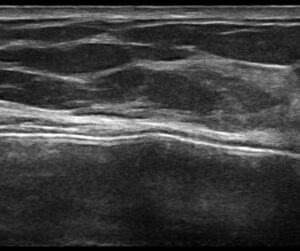
If a silicone implant leaks, breathe. It is not flying all around your body. Again, extracapsular spread is rare. If it did leak beyond the capsule, it would be locally into the breast, the pectoralis muscle, or the local lymph nodes. If it made it past there, it would not make it past the lung, which is a giant filter. In my career, I have NEVER seen this issue in a breast augmentation patient.
The information provided on this website is for general informational purposes only and does not constitute medical advice, diagnosis, or treatment. Always seek the advice of a qualified healthcare provider for any questions regarding your health or medical condition.