Posted on April 22, 2026
What is capsular contracture?
I saw a patient today with capsular contracture and her implants were only a year old. She wants it fixed. I did not do her original surgery.
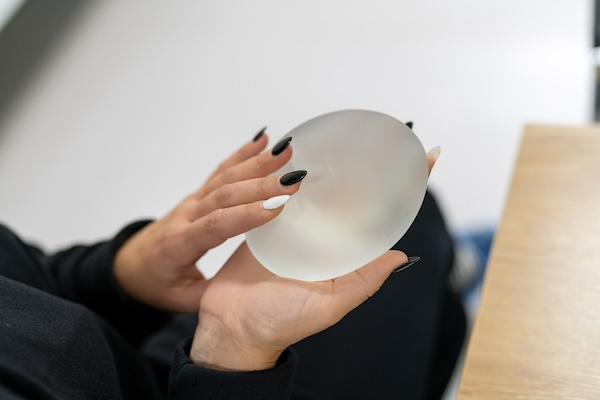
What is capsular contracture? It is when your “implant turns hard.” Your body has a reaction to the foreign object (here your breast implant) and forms a balloon of scar around it to separate the breast from your body. Everyone with an implant has a capsule. We grade it on a scale of I – IV, with IV being rock hard and distorts the breast shape. Frequently this is seen as a narrow, high implant with unnatural shape in the cleavage area.
People fix capsular contractures because it is not like the other side, it hurts, you can’t lie on your tummy or hug people, and it can signal other issues (implant leak, biofilm, breast implant illness). The likely etiology for capsular contracture is biofilm, a low grade infection. PREVENTION IS KEY. It is why I have a 14 point plan of things I do with every breast augmentation to try to avoid this. PLAN
What is ADM? Mesh?
ADM = acellular dermal matrix. This can be derived from human cadaver dermis or pig dermis. Brands= Alloderm, Strattice
MESH= a man made polymer of mesh. Brand = Galaflex
ADM or mesh are used in breast surgery for a multitude of reasons. It can help reinforce thin tissue, gradually replaced by your body’s own tissue. Uses are to fix:
- Rippling or wrinkling
- Visible implant or edge
- Implant migration
- Reduce risk of capsular contracture.
It is this last point I want to address here. Does it reduce capsular contracture?
What do studies show? Should you use ADM or mesh to prevent capsular contracture?
SUMMARY: The results are mixed.
There are for sure studies that show ADM reduces capsular contracture, particularly in breast cancer reconstruction with implants. Synthetic mesh data is more limited, but studies show benefit in revision cases. No studies have shown need in routine first time breast augmentation.
Why do they think it works? They think the ADM causes an alteration in collagen deposition patterns, lower myofibroblast formation, and decreased inflammation. All of these cause the capsule scar tissue to be softer and thinner.
ADM Studies showing benefit:
- A 2023 meta-analysis of ADM for capsular contracture treatment in breast augmentation. FINDINGS? low capsular contracture rates 1.53% for Strattice. This was lower than conventional arm.
- A 2012 study using Strattice in 154 breasts (both .treatment and prevention) showed 3.75% Baker grade III/IV contracture over 3.5 years.
- Efficacy varied significantly by ADM type—AlloDerm, FlexHD, and DermaMatrix had 0% contracture rates, while NeoForm and SurgiMend had 25% rates
- This was a small sample size.
- A 2020 meta-analysis of breast reconstruction. Capsular contracture incidence of 2.4% with ADM use, with human-derived ADM better 1.2% than other types.
Mesh Studies showing benefit:
- 2023 study of GalaFLEX in revision augmentation (submuscular to subglandular conversion) reported no capsular contracture in 34 patients over 6-28 months.
- A 2023 institutional review found subglandular reconstruction with ADM/mesh had the lowest capsular contracture rates, but ADM was associated with significantly higher infection and wound dehiscence rates.
- A 2025 Cochrane review noted insufficient evidence supporting mesh use in breast reconstruction, with the FDA releasing a statement about inadequate evidence for mesh in this setting.
Studies Showing Limited/No Benefit:
- The BRIOS randomized trial showed data on ADM benefits remain inconclusive, with most studies having high selection bias and complication rates ranging from 4-50%.
- A 2026 meta-analysis found that when you assessed the data looking at implant surface type, capsular contracture rates did not differ significantly between subfascial and subglandular placement with smooth implants 8.2% vs 10.3%,
- This suggests reported benefits may have been confounded by implant selection rather than the adjunct materials themselves.
In the analysis, a great point was made. Many of these studies are in breast cancer reconstruction or the implants are subglandular (ie in front of the pectoral muscle, not submuscular). SUBGLANDULAR PLACEMENT IS A KNOWN RISK FACTOR FOR CAPSULAR CONTRACTURE. “It is unclear whether ADM or mesh can fully reduce the baseline increased risk in primary aesthetic breast augmentation cases.”
Dr. Greenberg’s thoughts on mesh and capsular contracture
I think this deep dive confirmed my understanding that the results are mixed. For sure there is no missive to use ADM or mesh in a first time cosmetic breast augmentation, whether in front of or behind the muscle. I did this deep dive for this patient as I wondered if my understanding was up to date. Were there new clarifying studies? Should you use ADM or mesh for a breast implant revision?
That is the crux of it. There is no clear answer.
- ADM and mesh add cost. There is the cost of the actual product, and there is the additional cost of the time in the OR to place it.
- Studies do indicate higher issues of infection and wound healing issues. Both of those are incredibly risky with implants and can involve the costs and treatments needed with antibiotics or other surgeries. Infections of implants lead to capsular contracture.
I reviewed with this patient what did your doctor do prior to your surgery and during your surgery to prevent biofilm and capsular contracture? Things like skin preps before surgery, Keller funnels, post operative Singulair have all been shown to help.
The biggest issue for her is likely the placement of the implant in front of the muscle. She is adamant to not change that.
So this comes down to a choice you get to make with me, your plastic surgeon. You are intelligent. You can read the studies cited to see the data. The data is inconclusive. So the question is what do YOU want to do? Do you want to feel like you did everything you could? Do you want to change the plane of the implant? Do you mind the cost of the ADM or mesh? Which of those do you want to try?
I am here to help you navigate. I have used all of these products. But the final choice is yours.
Medical citations
- Efficacy of Acellular Dermal Matrix Type in Treatment of Capsular Contracture in Breast Augmentation: A Systematic Review and Meta-Analysis.Aesthetic Surgery Journal. 2023.
- Use of Dermal Matrix to Prevent Capsular Contracture in Aesthetic Breast Surgery.
Plastic and Reconstructive Surgery. 2012.
- Efficacy of Acellular Dermal Matrix in Capsular Contracture of Implant-Based Breast Reconstruction: A Single-Arm Meta-Analysis.Aesthetic Plastic Surgery. 2020.
- Inhibition Mechanism of Acellular Dermal Matrix on Capsule Formation in Expander-Implant Breast Reconstruction After Postmastectomy Radiotherapy.Annals of Surgical Oncology. 2018.
- Synthetic Reabsorbable Mesh (GalaFLEX) as Soft Tissue Adjunct in Breast Augmentation Revision Surgery.Aesthetic Surgery Journal. 2023.
- ADMs and Synthetic Meshes Improve Implant-Based Breast Reconstruction Aesthetics, but at What Cost?.Journal of Plastic, Reconstructive & Aesthetic Surgery : JPRAS. 2023.
- Mesh for Immediate Implant-Based Prepectoral Breast Reconstruction Following Mastectomy.The Cochrane Database of Systematic Reviews. 2025.
- Quality of Life and Patient Satisfaction After One-Stage Implant-Based Breast Reconstruction With an Acellular Dermal Matrix Versus Two-Stage Breast Reconstruction (BRIOS): Primary Outcome of a Randomised, Controlled Trial.The Lancet. Oncology. 2018.
- Capsular Contracture Rates in Subfascial and Subglandular Breast Augmentation With Smooth vs Textured Implants.Aesthetic Surgery Journal. 2026.
- Systematic Review of Capsular Contracture Management Following Breast Augmentation: An Update.
Plastic and Reconstructive Surgery. 2024.
- Risk Factor Analysis for Capsular Contracture: A 10-Year Sientra Study Using Round, Smooth, and Textured Implants for Breast Augmentation.Plastic and Reconstructive Surgery. 2018.
- Risk Factors for Developing Capsular Contracture in Women After Breast Implant Surgery: A Systematic Review of the Literature.Journal of Plastic, Reconstructive & Aesthetic Surgery : JPRAS. 2018.
The information provided on this website is for general informational purposes only and does not constitute medical advice, diagnosis, or treatment. Always seek the advice of a qualified healthcare provider for any questions regarding your health or medical condition.
This blog has been authored by Dr. Lauren Greenberg
Dr. Lauren Greenberg is a Stanford-trained, board-certified plastic surgeon who brings over two decades of experience and a strong commitment to natural-looking results. She is known for combining advanced techniques with an honest, thoughtful approach to help patients feel confident and empowered.